The first recordings traveled farther than Rihanna had. Robyn Rihanna Fenty was a teenager in Barbados when American producer Evan Rogers heard her sing, recorded demos with her and helped bring those songs to the United States. “Pon de Replay” reached Jay-Z at Def Jam and led to a record deal, followed by Music of the Sun in 2005. The album kept Caribbean rhythm and dancehall close to the center of her introduction, while A Girl Like Me arrived less than a year later and produced “SOS,” her first Billboard Hot 100 No. 1. The speed mattered. Rihanna entered pop without enough downtime to harden into one version of herself, leaving room for the records that followed to change her sound, styling and scale almost as quickly as audiences could absorb them.
“Umbrella” made that acceleration enormous in 2007. The Jay-Z collaboration spent seven weeks at No. 1 on the Hot 100, won Rihanna her first Grammy and anchored Good Girl Gone Bad, where “Don’t Stop the Music,” “Shut Up and Drive” and “Disturbia” moved her toward harder dance production and a more controlled visual identity. Rated R darkened the atmosphere in 2009, then Loud swung toward saturated pop through “Only Girl (In the World),” “What’s My Name?” with Drake and “S&M.” Talk That Talk followed with the Calvin Harris-produced “We Found Love,” another Hot 100 No. 1, and Unapologetic became her first No. 1 album on the Billboard 200 in 2012. Five major album eras had passed in roughly five years, an unusually compressed run in which reinvention happened before nostalgia had much chance to form around the previous record.
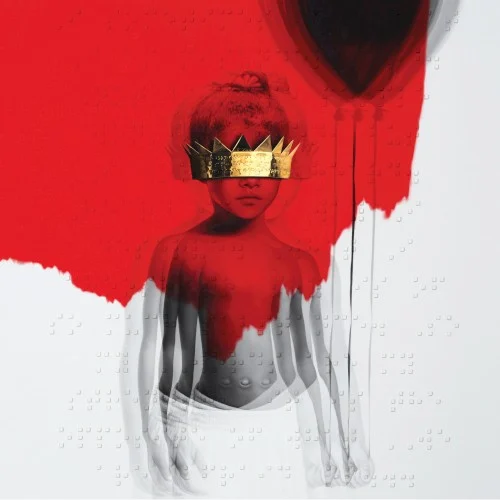
ANTI changed both the music and the clock. Released in 2016, Rihanna’s second Billboard 200 No. 1 moved away from the rapid succession of obvious pop campaigns and into the hazy minimalism of “Needed Me,” the guitar tension of “Kiss It Better,” the soul phrasing of “Love on the Brain” and the dancehall pulse of “Work” with Drake. “Work” became her 14th Hot 100 No. 1, but the album’s endurance eventually became just as remarkable as its singles. In 2025, ANTI became the first album by a Black female artist to spend 500 weeks on the Billboard 200. Rihanna has not released another studio album since. Instead, new music has appeared selectively through collaborations and films, including “Lift Me Up” from Black Panther: Wakanda Forever, which earned her first Academy Award nomination, and 2025’s “Friend of Mine” from Smurfs.
The years without album nine have hardly been empty. Fenty Beauty launched in 2017 with 40 foundation shades and helped make a broader range of complexions a more visible expectation within the cosmetics industry, while Savage X Fenty expanded Rihanna’s name into lingerie and fashion. She returned to one of music’s largest stages for the 2023 Super Bowl halftime show, performing a hit-heavy set without using the appearance to announce an album. The durability of those songs produced an even clearer measure in April 2026, when Rihanna became the first woman to surpass 200 million RIAA-certified single units in the United States, reaching 200.5 million despite having gone a decade without a new studio record. She also made a rare musical appearance with Jay-Z at Yankee Stadium in July, performing “Run This Town” and “Bitch Better Have My Money.”
The studio, however, is active again. Rihanna revealed a late-night recording session in February 2026, and A$AP Rocky confirmed in August that she was still working in the studio, without offering a project title, collaborators or timetable. That uncertainty now feels almost like the inverse of the career that produced it. Rihanna once released records quickly enough that Good Girl Gone Bad, Rated R, Loud, Talk That Talk and Unapologetic could all arrive within roughly five years. The decade after ANTI has produced no equivalent rush, yet the catalog has kept accumulating certifications, streams, chart longevity and new listeners without another album cycle to replenish it. Her first era demonstrated how effectively a pop career could be built through constant motion. The years since ANTI have demonstrated something far less common, Rihanna can withhold the very thing pop careers are supposed to require and still have the old music keep getting bigger.