The notebook was the original source of authority. Taylor Alison Swift began writing songs as a child in Pennsylvania and moved with her family to the Nashville area as a teenager, pursuing country music with an unusual insistence on participating in the writing itself. After leaving an early development deal with RCA, she signed with the newly formed Big Machine Records and released Taylor Swift in 2006 at 16. “Tim McGraw” introduced a writer interested in memory, specific objects and the emotional charge of small details, while “Teardrops on My Guitar” and “Our Song” widened her audience. Swift wrote or co-wrote every song on the debut. Authorship was therefore not something she claimed after becoming famous, it was part of the career before fame had fully arrived.
Fearless turned that writing into mass-market pop storytelling in 2008. “Love Story” rebuilt teenage romance around Shakespeare, “You Belong with Me” found drama in an ordinary unrequited crush, and the album won the Grammy for Album of the Year. Swift then wrote Speak Now entirely by herself before Red stretched her country foundation through the pop precision of “We Are Never Ever Getting Back Together,” the electronic attack of “I Knew You Were Trouble.” and the long-form narrative of “All Too Well.” 1989 completed the transition in 2014, replacing country instrumentation with synthesizers and tightly engineered pop on “Shake It Off,” “Blank Space” and “Style.” Its Album of the Year victory gave Swift two wins in the category before she turned 27 and confirmed that changing genre had not required surrendering the songwriter at the center of the records.
Control became increasingly visible in the albums themselves. reputation answered a period of intense public scrutiny with heavier electronics and a deliberately confrontational visual language, while Lover arrived after Swift moved to Republic Records. The pandemic then produced an unexpected contraction. folklore and evermore favored piano, acoustic guitar, muted electronics and fictional characters, with Aaron Dessner joining Jack Antonoff as a central collaborator. folklore won Album of the Year in 2021, making Swift the first woman to win the category three times. Midnights returned to nocturnal synth-pop in 2022 and won the same award in 2024, giving her a record fourth victory. By then, the recurring feature across the catalog was not one genre but Swift’s ability to reorganize songwriting, production and imagery around a clearly defined album world.
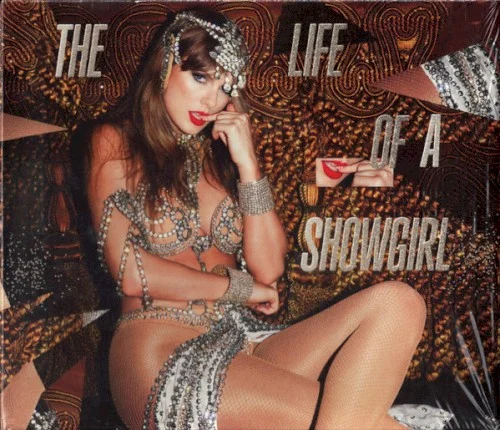
Ownership eventually made that creative argument literal. After the masters of her first six albums changed hands without belonging to her, Swift began rerecording the catalog as Taylor’s Version releases, adding vault songs while recreating Fearless, Red, Speak Now and 1989. The Eras Tour then placed those histories together onstage across 149 shows from 2023 through December 2024, while The Tortured Poets Department arrived during the run with an unusually dense collection of relationship writing and self-interrogation. In May 2025, Swift purchased the masters of her first six albums, finally bringing the original recordings under her ownership as well. The Life of a Showgirl followed on October 3rd, reuniting her with Max Martin and Shellback for a 12-track pop album shaped partly by the energy of performing the Eras Tour and producing No. 1 singles including “The Fate of Ophelia” and “Opalite.”
The latest extension of that control is increasingly visual as well as musical. Swift directed videos from the Showgirl era, including “The Fate of Ophelia” and “Opalite,” and on September 27th she is set to receive the inaugural MTV VMA Artist Director Honors, recognizing artists whose work behind the camera has advanced music-video storytelling. Two days earlier, she will release “Patient Zero,” announced on September 22nd after a countdown and cryptic changes across her online presence. The single follows 2026’s “I Knew It, I Knew You” from Toy Story 5, and Swift’s official store is offering standard, acoustic and piano editions of “Patient Zero,” although no new tour accompanied the announcement. That sequence gives the first 20 years of her career an unusually clear shape. Swift began by insisting that the words attached to her name were hers, spent years fighting to control the recordings of those words, and now increasingly directs the images surrounding them too. The scale has changed almost beyond recognition since “Tim McGraw,” but the organizing principle has not. Taylor Swift keeps moving outward from the song while making sure the creative center stays with its author.