

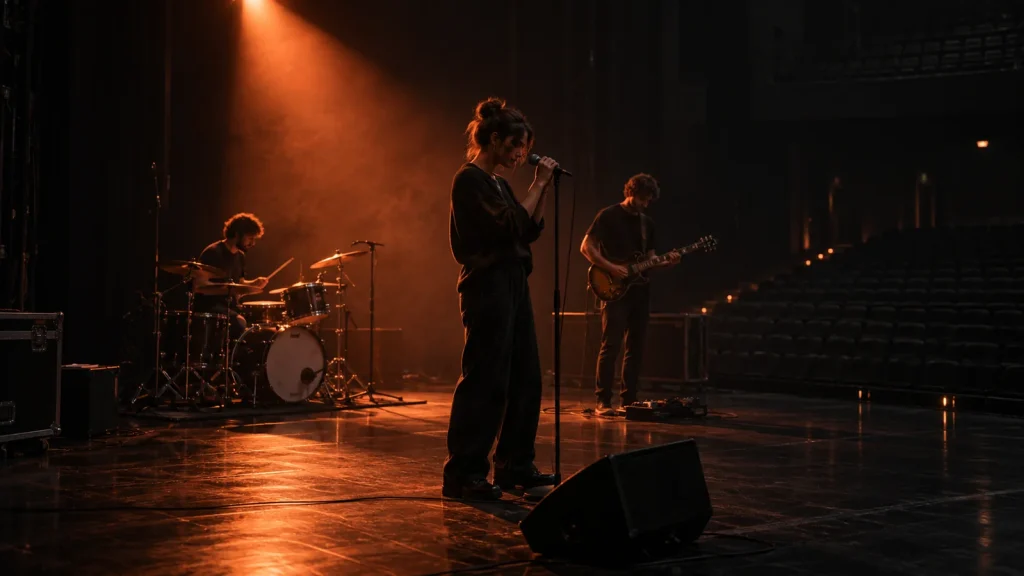
A song can feel completely secure in the practice room and surprisingly unfamiliar the moment another person sits down to listen. Hands tighten. A lyric that has survived dozens of rehearsals suddenly disappears. The difficult passage goes fine, then an easy entrance gets missed because attention is somewhere else entirely.
The music did not change. The conditions did.
Musicians spend enormous amounts of time practicing the material they intend to perform, but the act of performing is itself something that can be practiced. Research on music performance anxiety has found meaningful differences between preparation and public performance, including changes in concentration, memory, physiological arousal, and concern about mistakes. Musicians in one study reported using different coping strategies across preparation, backstage, and performance periods, with concentration becoming especially important once they were actually performing.
A Rehearsal Can Remove Too Many Consequences
Private practice is unusually forgiving. A player can stop after a mistake, restart a phrase, check a lyric, repeat four bars, adjust a pedal, or try the beginning again. Those are valuable ways to learn, but they also remove one of the defining conditions of performance: the music has to continue.
That difference can remain hidden until the first audience appears. A guitarist may know every chord yet have little experience recovering after landing on the wrong one. A singer may have memorized the lyrics but never practiced continuing after losing a word. A pianist may have drilled the hardest measures repeatedly while rarely playing the entire piece from beginning to end without interruption.
Preparation therefore needs more than correction. At some point, musicians need uninterrupted runs in which stopping is no longer available. A mistake becomes something to absorb while the performance keeps moving.
This changes what practice reveals. The question is no longer simply whether the musician can play each part correctly. It becomes whether the whole performance survives imperfect moments.
Memory Feels Different When Restarting Is Gone
Repeatedly beginning a difficult section from the same measure can make that location extremely familiar while leaving the surrounding transitions less secure. The player knows how to start there because practice has created an artificial entry point that may never occur onstage.
Performance runs expose those dependencies. Can the second verse begin without mentally replaying the first? Can a player recover at the next phrase if the previous one goes wrong? Can a singer enter the bridge after a distraction without needing to reconstruct everything that came before?
A recent review of music performance anxiety discusses the potential value of retrieval practice as a preparation strategy. Drawing partly on broader memory research, the authors propose that actively retrieving material rather than simply restudying it may be useful for strengthening access to memorized music under pressure. The approach is promising, but it should not be treated as a proven music-specific cure for performance anxiety.
For performers, the principle suggests practicing more than one route through the music. Start from several meaningful points. Rehearse entrances after rests. Run the final section without playing the beginning first. If memory fails, identify where recovery becomes possible instead of automatically returning to bar one.
The Audience Can Start With One Person
Performance practice does not require booking a show. The conditions can be scaled.
A first run might be recorded on a phone with the rule that the take cannot be stopped. Another might be played for one friend. The next could happen in front of a few people, at an open mic, during a rehearsal where everyone agrees to treat the run as a performance, or in the actual venue before the event.
The important change is that the run carries some consequence. Someone is listening, a recording is being kept, or the musician has committed to reaching the end without restarting.
Evidence supports making this kind of exposure part of preparation. A study examining repeated live performances found that repeated stage exposure was associated with reductions in heart rate, restlessness, and playing errors linked to music performance anxiety. The researchers argued that stage training belongs in practice, particularly because realistic public exposure cannot be fully recreated through private repetition alone.
A larger 2026 study of professional and amateur musicians also found that greater lifetime public performance experience was negatively associated with music performance anxiety. That does not mean simply performing more will eliminate anxiety for every musician, but it reinforces the distinction between knowing music privately and accumulating experience delivering it publicly. The study included musicians with a wide range of public performance experience.
Pressure Reveals Where Attention Goes
A musician can know exactly what to do and still direct attention somewhere unhelpful during performance. Instead of hearing the phrase, attention moves toward the fingers. Instead of following the groove, the performer starts evaluating the previous mistake. Instead of communicating the lyric, they wonder whether the audience noticed a shaky note.
That inward monitoring can change a well-practiced action. Research into attentional focus in musical performance has examined how directing attention internally or externally can affect technical and expressive outcomes. A systematic review of attentional focus found a growing body of experimental work in music, while also noting that differences in tasks and outcome measures make simple universal rules difficult.
This is useful precisely because it discourages one-size-fits-all advice. A musician may need detailed internal attention while solving a technical problem during practice, then a broader musical target while performing. Research on repeated stage exposure similarly discusses shifting attention toward musical aspects rather than remaining locked onto errors or analytical self-monitoring during execution.
A practical performance cue should therefore be musical enough to survive pressure. Instead of carrying ten technical reminders onstage, a singer might focus on where one phrase is headed. A drummer might anchor attention to the relationship with the bass. A pianist might listen for the upper melodic line rather than consciously supervising every finger.
Recovery Deserves Its Own Rehearsal
Musicians usually practice the version in which everything works. Performance preparation becomes stronger when it also includes a plan for the version in which something does not.
That does not require deliberately sabotaging every run. It means noticing what happens naturally after an error. Does one wrong note cause three more because attention stays attached to it? Does forgetting one lyric line derail the entire verse? Does a missed cue make the player rush while trying to catch up?
Recovery can be practiced directly. During an uninterrupted run, keep going after the mistake and locate the next secure landmark. For a singer, that might be the next lyric phrase or chorus entrance. In an ensemble, it could be a drum fill, chord change, or structural cue everyone recognizes. For a solo instrumentalist, it may be the beginning of the next phrase rather than the exact note where the error occurred.
This develops a different skill from accuracy. Accuracy reduces the likelihood of a mistake. Recovery reduces the damage when one happens.
The distinction matters because concern about errors is itself part of performance anxiety for many musicians. Research comparing musicians across the preparation and performance cycle found that fear of mistakes and negative evaluation contributed to anxious responses, while concentration on the performance was among the strategies musicians used to cope. The same research also documented techniques such as slower practice, repetition of difficult passages, dress rehearsals, and performance-focused concentration.
Your Pre-Show Routine Is Part of the Performance
Performance practice can also reveal what happens before the first note. A musician who always rehearses in a quiet room after twenty minutes of warming up may discover that the real event offers a noisy backstage area, a short soundcheck, cold hands, unfamiliar monitoring, and a long wait before going on.
A useful routine does not need to become elaborate or superstitious. It needs to make the transition into performing more familiar.
That may include deciding how much warm-up is actually useful, checking essential equipment in the same order, knowing what will happen immediately before walking onstage, and having a small number of musical cues ready for the opening moments. Research into musicians’ coping strategies has documented approaches including mental rehearsal, breathing, physical activity, simulated performance, self-talk, and task-focused musical or technical instructions. Those strategies vary considerably among performers and situations.
The routine should support the music rather than become another performance the musician is afraid to get wrong. If a particular warm-up is unavailable, the show still has to happen.
Do Not Judge a Performance Run Like a Practice Take
A simulated performance produces different information from ordinary practice, so it should be evaluated differently. Stopping after every imperfection defeats much of its purpose.
Finish first. Then review.
Instead of cataloging every wrong note, look for patterns that affected the performance as a whole. Perhaps the opening tempo was consistently too fast. Maybe memory became less secure after a particular transition. The vocal could have tightened only after one demanding section. An ensemble might have lost connection whenever monitoring made one player difficult to hear.
Those observations can feed the next practice session. Technical work returns where necessary, but now it is informed by what happened under performance conditions rather than by what seemed difficult in isolation.
This is also where recording a full run becomes useful. The feeling of performing and the sound of the performance are not always identical. Something that felt disastrous may barely register on playback, while a tempo change or loss of phrasing that went unnoticed in the moment may be obvious afterward.
The Stage Does Not Have to Feel Like Practice
Public performance may never feel identical to private practice, and it does not have to. A 2026 review examining flow and music performance anxiety found that the relationship between the two is more complicated than treating anxiety and effective performance as simple opposites. Across the literature, greater anxiety was generally associated with less flow, but the authors also discuss circumstances in which manageable levels of activation can coexist with effective performance. The review emphasizes that the evidence remains heterogeneous rather than supporting one universal response to performance pressure.
That changes the purpose of performance preparation. Trying to eliminate every sign of activation before walking onstage may be less useful than knowing how to perform while the body is activated. A faster heartbeat does not automatically mean the preparation has failed.
Private practice builds the music. Performance practice tests what happens when the music has to survive attention, memory demands, mistakes, physical activation, an audience, and the inability to start again. Those conditions deserve rehearsal too.